Date & Time
Fri, Jun 26, 7:00 PM
Price
$38.07
Tickets
About
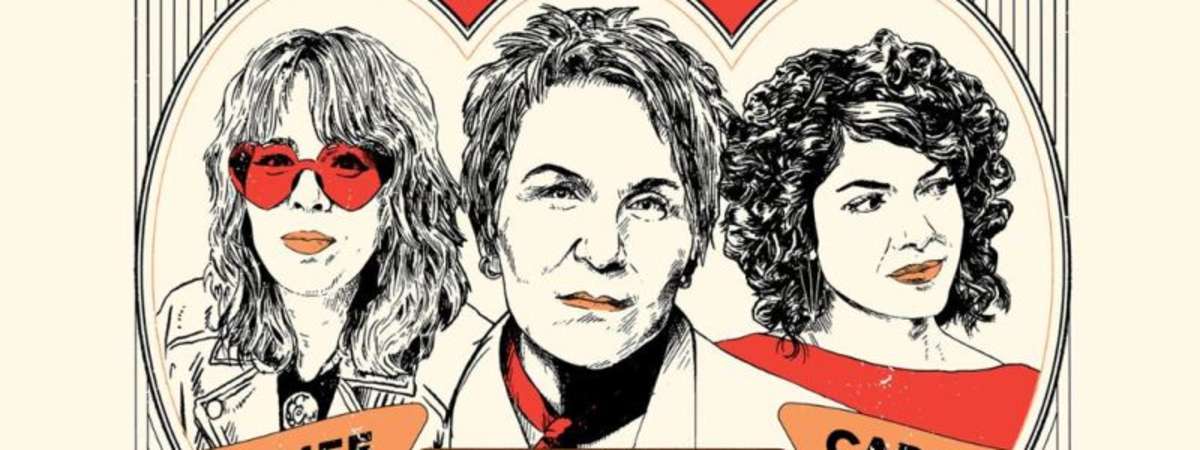
Mary Gauthier Mary Gauthier is a Grammy-nominated American folk singer-songwriter and author, known for songs that blend emotional resonance, depth of character, and lyrical insight. Her storytelling—raw, honest, and unwavering—has established her as one of America’s most compelling voices, offering beauty in sorrow, healing in loss, and perspectives only an artist of profound empathy can provide. Gauthier’s songs have been recorded by artists including Tim McGraw, Blake Shelton, Kathy Mattea, Boy George, Jimmy Buffett, Vince Gill, Bettye LaVette, and many more. She has received honors from the Americana Music Association, International Folk Music Awards, the Independent Music Awards, the GLAMA Awards, and the UK Americana Association. Her work has appeared extensively in film and television, including Yellowstone and ABC’s Nashville, and her memoir, Saved by a Song, was published by St. Martin’s Press. Jaimee Harris Jaimee Harris turned 30 during the pandemic. It’s a milestone that is a rite of passage even during normal times. But for this Texas-born singer-songwriter, it came in the midst of one of the strangest and most tumultuous periods in American history. When the world stopped during lockdown, Harris, like many others, found herself gazing back into the past, ruminating on the nature of her hometown and family origins, and reckoning with their imprint on her. The term ‘nostalgia’ derives from the Greek words nostos (return) and algos (pain), and if Harris’s Boomerang Town can be regarded as a nostalgic album, it is only nostalgic in the sense that the longing for home is a desire to return to the past and heal old wounds. “I’m at an age where I’m wrestling with trying to understand the nature of my family,” Harris says. “There’s been suicide, suicide ideation, and there’s certainly been addiction all through my family. My dad’s father died of suicide when he was 25 and I was 5. I couldn’t imagine not having my dad right now.” Harris’s sophomore effort, Boomerang Town marks a bold step forward for this country-folk-leaning singer-songwriter. It is an arresting, ambitious song-cycle that explores the generational arc of family, the stranglehold of addiction, and the fragile ties that bind us together as Americans. For Harris, the album began gestating around 2016, a time of great loss for many in the Americana community, with the songwriter losing several musicians close to her. The shift in the nation’s political landscape had ushered in a new level of polarization that saw whole swaths of cultural life being demonized. For someone who grew up in a small town outside of Waco, Harris believed the values instilled in her by her parents were not entirely in line with how many on the left were viewing — and vilifying — Christians, citing them as responsible for the new change in leadership. As a person in recovery, Harris has had to re-evaluate her own connection to faith and find strength in a higher power (“Though he’s not necessarily a blue-eyed Jesus,” she laughs), though she certainly knows what it’s like to “be told how to vote” in a Southern church setting. It was from the intersection of these social, personal, and political currents the album was born. And while much of the material on Boomerang Town was inspired by personal experience, the songs on this collection are far from autobiographical xeroxed copies. More than anything, they come from a place of emotional truth. Boomerang Town traces the fortunes of a host of characters who live on the knife’s edge between hope and despair. The title track, whose sound recalls the best of Mary Chapin Carpenter’s ’90s work, features a young couple from a small-town working dead-end jobs who get “knocked up” and have their dreams put on hold. It is a portrait of rural desperation and the restless search for salvation against long odds. “This is what it’s like to be a part of the post- “‘Born To Run’ Generation,” Harris quips. “Springsteen’s generation had somewhere to run to. I’m not so sure mine does.” For the characters in these songs, escape isn’t always a matter of geographical distance. “I tried a lot of perspectives [on this one],” Harris says about writing the title track. “My parents are high-school sweethearts and I was an accident and they’re still happily married. I worked at Wal-Mart when I was 19. I reflected on this guy who was the brother of a good friend of mine. He didn’t drop out. He knocked up his girlfriend and went into the military. Certainly [the song] is a combination of me and not me. It was me thinking about what might have gone differently for my parents, who are still in Waco and own a business there.” Harris’s father, whom she counts as a big supporter and responsible for much of her musical education, took her to the first Austin City Limits Music Festival, where she had the life-changing, Eureka moment of seeing Emmylou Harris, Patty Griffin, and Buddy and Julie Miller perform on stage at the same time. It was then the young Harris knew what she had to do. She had found her ticket out. Harris continues: “Why was I able to get out of my boomerang town? Why are others stuck there, longing to leave but unable to find their way out? Writing these songs, bringing these narrators to life, brought me closer to the answers,” she says. Themes of grief and addiction permeate other sections of the record. “How Could You Be Gone,” which Harris wrote with her partner, the venerable folk songwriter Mary Gauthier, reflects on the passing of a close friend during the pandemic, as well as the 2017 death of Harris’s mentor and compadre Jimmy LaFave, a long-time fixture on the Americana scene who succumbed to cancer. “It’s been my experience that grief operates on its own timeline,” Harris says. “I wanted this track to build and repeat with intensity to mirror the experience of relentless grief.” Another song, “Fall (Devin’s Song),” is about a former childhood classmate of Harris’s who was accidentally shot and killed in the sixth grade. The song was inspired by a series of “In Memoriam” pieces the boy’s mother wrote to the local paper, and the song serves as a tribute to both of them, as well as a commentary on the timeless nature of grief. One of the album’s standout tracks is the lilting, Irish-influenced “The Fair And Dark Haired Lad,” a Chicks type-number that grapples with the seductive nature of alcohol. Another tune that deals with the demon rum, “Sam’s,” is far more dirge-like, and its dark, circular melody mirrors the claustrophobia and sense of trapping that comes with the onset of addiction and mental collapse. Boomerang Town is not entirely a lament, however, with songs like “Love is Gonna Come Again” and the wistful “Missing Someone” shining with hope in the face of the darkness. For this is a record that understands that love and grief are two sides of the same coin. It also announces the arrival of a great new songwriter on the scene. “My goal is to just write the best possible song I can write,” Harris says, “and I wanted to have ten songs that made sense together sonically. I still believe in the album format, and I wanted to lay the groundwork as a solid songwriter.” On Boomerang Town, Jaimee Harris, who was able to find her way out — unlike so many others — has accomplished all that, and much more. Carrie Rodriguez “The self-proclaimed ‘half-gringa, half-Chicana fiddle[r]’ has made an album that combines seemingly disparate influences into one gloriously cohesive Spanglish statementThe seemingly improbable cultural mashups are a perfect expression of reality for many folks in Texas and beyond.” —NPR Music “The melding of cultures can be a beautiful thing, especially when orchestrated by such a talented cast. The Sacred Hearts includes bassist Viktor Krauss and the ubiquitous guitarist Bill Frisell putting their special stamp on the material.” —Associated Press “Rodriguez has been hinting at the ambition displayed on Lola for some time. What’s surprising is how a record of such scope and imagination can be rendered so intimately and elegantly.” —All Music Carrie Rodriguez, a composer, violinist, and singer from Austin, Texas, finds beauty in the cross-pollination of diverse traditions. As a singer-songwriter she has released 5 solo studio albums, 3 duet albums with legendary Chip Taylor (author of “Wild Thing and “Angel of the Morning”), and 2 live albums. Her last full-length solo recording, the bilingual Lola, was heralded as “the perfect bicultural album,” and was included in NPR’s best albums of 2016 as well Rolling Stone’s Best Country albums of the year. Carrie has performed on stages across North America and Europe, as well as on programs such as PBS’ Austin City Limits, The Tonight Show, and NPR’s Tiny Desk Concerts. In 2017, Carrie founded a highly acclaimed ongoing concert series which resides at the historic Stateside at the Paramount Theatre in Austin, Texas called Laboratorio that both celebrates and explores Latinx culture and its contribution to the American experiment. Her most recent work has been as a composer/lyricist for an original musical, ¡Americano!, chronicling the true story of an inspiring DREAMer named Tony Valdovinos, which enjoyed a successful 6 week run off-broadway at New York City’s New World Stages in June of ’22, and also earned Rodriguez a nomination for a ’22 Drama Desk award for Outstanding Music.
About the venue
Historic theater staging music shows, performance art & films, with a separate dining area/bar.
Performing
In a Nashville bookstore, to the tune of steam hissing from a latte machine and laptop taps of nearby browsers, she speaks in a low voice, yet communicates urgently. Her voice never rises. Her music never rattles rafters or crashes like cymbals toward the high notes in a power chorus. Her tempos shuffle and trudge more than they dash. And her songs? They're about as idiosyncratic as anything in the wide world of "popular music." They're painfully personal, especially on Trouble and Love. Yet they somehow infiltrate the souls of her listeners, no matter how different the paths they've followed through their lives. Those songs weren't so much written as harvested by Gauthier. Though she lives not far from the hit-making mills of Music Row, she admits to knowing nothing about how to write on command. She says, "I have to be called to write. The call comes from somewhere I don't understand, but I know it when I hear it." That call first came to her a long time ago. Her life to that point had led her to extremes, plenty of negatives and a few brilliant bright spots. An adopted child, who became a teenage runaway, she found her first shelter among addicts and Drag Queens. Eventually she achieved renown as a chef even while balancing the running of her restaurant with the demands of addiction to heroin. Two more successful restaurants, an escalating addiction, and a subsequent arrest, led her into sobriety. All that was rehearsal for what to follow, when she wrote her first song in her mid-thirties. From that point, Gauthier channeled a long line of works, almost all of them eloquent in their insight, burnished by her writing technique. A core of devotees came to await each next release. Their wait ends, for now, with Trouble and Love. <br> This time, Gauthier's songs rise from what she describes as an especially dark period. "I started the process in a lot of grief," she explains. "I'd lost a lot. So the first batch of songs was just too sad. It was like walking too close to the fire. I had to back off from it. The truth is that when you're in the amount of grief I was in, it's an altered state. Life is not that. You go through that. We human beings have this built-in healing mechanism that's always pushing us toward life. I didn't want to write just darkness, because that's not the truth. I had to write through the darkness to get to the truth. Writing helped me back onto my feet again. This record is about getting to a new normal. It's a transformation record." The heart of that transformation, beating within Trouble and Love, is love. But it’s not the kind of love that's celebrated on pop charts. In those tunes, love is its own end; the story stops as the giddiness sets in, with no hint of what may follow. Gauthier knows better; she has the scars to prove it. "For me, love has been a real challenge," she admits. "Attachment has been a challenge. This record is about losing an attachment I actually made. The loss of it was devastating because I hadn't fully attached before to anyone. The good news is that I can. The even better news is that I can, and I can lose, and live. Not only do I live, but I've got a strength that I never had before." Trouble and Love would fall or rise on the question of whether it crystalizes Gauthier's experience and conveys it to those who want to feel it, as if the poetry of her lyric can mirror and illuminate what they too have gone through. To help make this happen, she invited a small group of singers and musicians into Nashville's Skaggs Place Studio, each one chosen because of his or her ability to find the heart of the song. No one was given a lead sheet or an advance demo or even headphones. The backup vocals were invented on the spot. The microphones were vintage, and the songs were cut live, to tape. Everyone stood together in the room, playing to what they heard in the lyric as well as from what was going on in the moment. "I took away everything that musicians lean on to feel invulnerable," she explains. All they had to work with was a brief rundown of each song from Gauthier in the control room, right before the tape rolled. "I wanted them to feel it in real time," she continues. "You don't want to sound real with songs like this. You want to be real. That’s what I strive for as a writer, and that's what we got in the playing." Feeling their way through the process, these extraordinary participants -- guitarist Guthrie Trapp, keyboardist Jimmy Wallace, bassist Viktor Krauss, drummer Lynn Williams and singers Beth Nielsen Chapman, Ashley Cleveland and Darrell Scott, Siobhan Kennedy and The McCrary Sisters -- probed and then brought life to Gauthier's compositions. In their hands, and in her fearless vocals, the songs resonate like tolling bells. We hear "a body's but a prison when the soul's a refugee" in Oh Soul. The last embers of affection flicker and die on When a Woman Goes Cold, (“Scorched earth cannot burn.”) "A million miles from our first kiss, how does love turn into this?" is just one of the bitter riddles posed in False From True. Irony colors the chorus of Worthy: "Worthy, worthy what a thing to claim. Worthy, worthy, ashes into flame." This is deep and dangerous poetry, and Gauthier leads us through it with relentless candor. Yet tenderness is always near, enough to keep us engaged through the final track, "Another Train." "I wrote that one in England during a long, long tour," she remembers. There was a sign at a station: There'll be another train at 14:02.' So I started working with 'another train.' The song evolved. It doesn't start the way it ends. It zigged and it zagged. I let it talk to me. It's so interesting, because when I saw 'another train,' boom, that whole story was in there -- but I had to go find it. I had to dig, like an archaeologist." In the very last line of the song is the benedictory thought of the entire album. "Another Train" bathes all of what preceded it in a glimmer of hope. It a fantastically concise and powerful ending -- and entirely intentional-- “There’ll be another train.” "This album reflects a total human experience. Love, loss, and a life transformed." Gauthier sums up. "It's not a random collection of songs. This record is a story. It's about trust and faith and believing that there's a plan and a flow. And the flow is where the good stuff is because there's wisdom in the flow. At the core, we're all cut from the same cloth-- the same dreams, the same brokenness, the same desire for companionship and family and home. Yeah, we all have that. And if I don't go deep enough into that, it's a problem. "There's no such thing as going too deep." Amen to that.
Jaimee Harris is poised to become the next queen of Americana-Folk, a slightly edgier Emmylou Harris for the younger generation. Her new album draws comparisons to Patty Griffin, Ryan Adams, and Kathleen Edwards – all writers who know how to craft a heartbreakingly beautiful song with just enough grit to keep you enthralled. Harris writes about the basic human experience, in a way that is simple, poetic, and often painfully relatable. "You keep comin over... I keep goin under..." Harris isn’t afraid to get personal, but her vulnerability never veers into the self-indulgent. Each little confessional gem she puts out there is something the listener will connect to; these are things we’ve all felt, though many of us are less than likely to admit them. “In a depressive state… how long will I feel this way?” Harris's songs have a depth to them, and her lyrics betray a wisdom beyond her years. “I write as a way of dealing with things," she says. "There’s also a lot of acknowledging my own faults. These songs feel pretty vulnerable… to the point where I wonder if people are going to ask me ‘Are you okay?’ But I really just hope they see a little bit of themselves in them."
At each stage of Carrie Rodriguez’s career—as a fiddler, singer, and songwriter—the Austin, Texas, native has learned the importance of letting go. That was certainly true when it came to recording her fourth solo album, Give Me All You Got, her first of largely original tunes in several years. “In the making of Love and Circumstance in 2008, I chose to sing other people’s songs,” Rodriguez explains. “I needed to take a step back from songwriting and think about the kinds of songs that feel important to sing. Doing that inspired me to write again.” On Give Me All You Got, she says, “I’m laying out some extreme emotional highs and lows, which feels good. Take ‘Brooklyn’ [co-written with guitarist Luke Jacobs]. It’s very autobiographical, and I remember thinking, would I really want to share this? I decided, of course, why hold this back? It’s something that a lot of people can relate to—the acceptance of failure in a relationship, learning from it, and moving forward. ‘Brooklyn’ is also a song about taking a pause in order to really experience what you are feeling, something I find increasingly difficult in this modern era of constant communication and stimulation.” Rodriguez, who came to attention a decade ago performing with singer-songwriter Chip Taylor, has established an impressive roster of touring, recording, and co-writing affiliations—with Lucinda Williams, Rickie Lee Jones, John Prine, Mary Gauthier, Alejandro Escovedo, guitarist Bill Frisell, and others. Although she has issued three albums under her own name and enjoyed major label support for 2008’s She Ain’t Me, the release of Give Me All You Got marks a giant step for Rodriguez. The album was recorded with her own band and produced by the renowned Lee Townsend, with whom she has worked closely in the past. And the songs—which she wrote, co-wrote, or handpicked from the repertoire of longtime collaborators—establish her musical identity more powerfully than ever before. While Carrie’s father, David Rodriguez, was an accomplished songwriter, and took her on tour with him in Europe when she was a teen, song craft, like improvising on fiddle and singing, didn’t come automatically to Carrie. After sitting in on a sound check with her dad’s old Houston pal Lyle Lovett, she detoured from a degree as a classical violinist at Oberlin Conservatory and set herself on course to become a fiddler at the Berklee College of Music. There, her teacher, Matt Glaser, and her fellow students, including roommate Casey Driessen, helped her “find my groove and let go of that wall I had put up as a classical player.” Another turning point came when Rodriguez met veteran songwriter Chip Taylor (“Wild Thing,” “Angel of the Morning”), who soon had Rodriguez touring and recording, and encouraged her to sing and write. “I’ve been a reluctant writer ever since I started, never quite feeling like I was supposed to be doing it,” Rodriguez confesses. “But I’m drawn to songs that are emotional and direct, and from working with Chip I learned that when you can just be open and not analyze too much, that’s when the truth comes out.” After recording three studio albums with Taylor, Rodriguez made her solo debut in 2006 with Seven Angels on a Bicycle. “All of a sudden I found myself in this position of being called a singer-songwriter, which felt so strange,” she says. But she returns to that role quite comfortably on Give Me All You Got. The album includes songs by Taylor and Ben Kyle (with whom Rodriguez recorded the 2011 EP We Still Love Our Country), but its emotional core resides in originals drawn from Carrie’s personal experience. “I feel less afraid to write about what’s really happening, both to me and to people around me,” Rodriguez says. The song “Sad Joy,” for instance, arose from a conversation with Taylor about a loved one who was maintaining a “bright, beautiful attitude” while dealing with Lou Gehrig’s disease. “Chip and I were talking about how, when we are faced with those kinds of things, as sad and difficult as they are, they can also bring about a type of joy. The simple joy of people loving each other and holding each other up—in times of both celebration and in mourning. We started strumming some chords, and there it was, a song that lays out those raw emotions without being shy about it. Celebrating them, in fact.” Give Me All You Got deals with a few dark themes, which is not surprising given that one of the first songwriters who inspired Rodriguez in her early teens was Leonard Cohen. “I listened to Leonard for a year and dwelled in the deep lowdown feelings he helped me feel,” she recalls. The sound of the new album, however, is “a little more infectious, rather than contemplative,” says producer Lee Townsend. “It still addresses Carrie’s roots in Americana, but also with a bit of a pop edge. I think it is her most mature record—every direction that is explored is distilled to an essential kind of expression.” Townsend, known for his work with Bill Frisell, Loudon Wainwright III, Kelly Joe Phelps, Crooked Still, and many others, captured the band—Carrie on fiddle, tenor guitar, and vocals; Luke Jacobs and Hans Holzen on acoustic, electric, and lap steel guitars, mandolin, and vocals; Kyle Kegerreis on upright and electric bass; Eric Deutsch on piano, Rhodes, and Hammond B3; and Don Heffington on drums and percussion—essentially live in the studio. “The live energy of the band is central to this album,” he says. “Ever since I first met and worked with Lee at a music festival in Germany, I have known he was the perfect producer for me,” Rodriguez says. “His approach to making an album is almost like a composer writing a symphony. He has the ability to group songs together and shape them so that the story they tell is a complete one, and even greater than the individual songs themselves. And like my favorite conductors, he manages to get the absolute best from each musician by making us all feel at ease and appreciated.” With the release of Give Me All You Got, Rodriguez is ready to say the same thing about herself: “As a singer-songwriter, I feel like I’m doing what I’m supposed to be doing. It’s a lifelong learning curve, and I hope I always stay as excited about it as I am now.”
About
Mary Gauthier Mary Gauthier is a Grammy-nominated American folk singer-songwriter and author, known for songs that blend emotional resonance, depth of character, and lyrical insight. Her storytelling—raw, honest, and unwavering—has established her as one of America’s most compelling voices, offering beauty in sorrow, healing in loss, and perspectives only an artist of profound empathy can provide. Gauthier’s songs have been recorded by artists including Tim McGraw, Blake Shelton, Kathy Mattea, Boy George, Jimmy Buffett, Vince Gill, Bettye LaVette, and many more. She has received honors from the Americana Music Association, International Folk Music Awards, the Independent Music Awards, the GLAMA Awards, and the UK Americana Association. Her w
Make this yours
Sign in to save this event, RSVP, see your match score, get AI parking & arrival tips, and chat about the event.
- ⭐Personalized match score
- 💾Save & track RSVPs
- 🅿️AI parking & arrival tips
- 💬Ask anything about the event