Date & Time
Fri, Jun 26, 6:30 PM
Price
$73–$621
Tickets
About
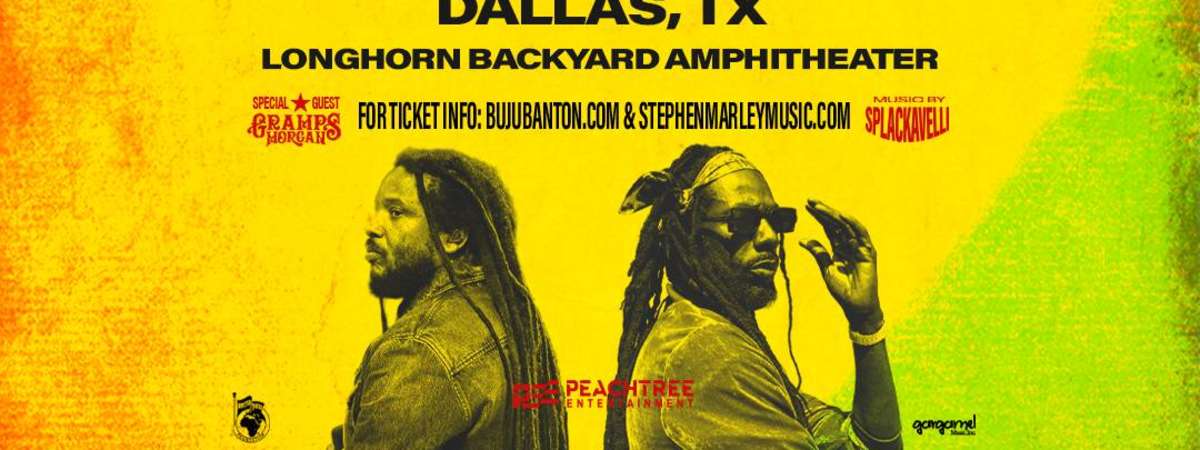
Buju Banton Buju Banton is unequivocally one of the world’s greatest dancehall/reggae artists. The man born in Salt Lane, Kingston as Mark Anthony Myrie, is also known to the world as living legend, Grammy winner, abolitionist and voice for oppressed people around the world. For over three decades, he dominated the reggae/dancehall sub-genre with iconic collaborations (Beres Hammond, Stephen Marley, Dave Kelly, Sly & Robbie, Bobby Digital, Steely & Cleevie, just to name a few), lyricis superior to peer and a ministry committed to liberating the minds of oppressed people. The father often sons and eight daughters has taught the world true romance (“Who Say”), radical discernment(“Hills And Valleys”), perseverance (“Not An Easy Road”), and how to bogle (“Bogle”). Bujuwas raised by two hardworking parents, the youngest sibling behind 16 daughters. His diligence, charm and charisma were passed down by his father, a factory worker. He inherited his entrepreneurial mind and passionate spirit from his mother, a market vendor with ancestry linked to the West African slave revolters, Maroons. Mama nicknamed her chubby baby after the Jamaican breadfruit Buju. Banton––representative of a fierce deejay––was later adopted by her son. As a youth, Buju studied reggae greats such as Major Worries, Admiral Bailey, Shabba Ranks, PapaSan and Lieutenant Stitchie. He often broke curfew to beg either older deejays for a couple minutes on the mic or security guards for entry into studios like Technique Records and Penthouse Recordings. The latter studio is where 16-year-old Buju recorded his first song, “The Ruler.” Recognized as a reggae prodigy, he was commissioned by DJ sets Rambo International, Sweet Love sound system (owned by Flourgon) to DJ for $100 a weekend. As young Banton’s hustle and connections grew, he linked up with a future great Capleton and began demanding up to $500 per dubplate. The early nineties is when Buju exploded onto the scene, helping catapult dancehall into a global force. Buju’s first underground hit to crossover, “Stamina Daddy,” became the title track for his 1992debut album (the LP was later repackaged and retitledQuick). Buju’s massive follow-up Mr. Mention, which wrought classics like “Batty Rider” and “Love Me Brownin’, ” dropped the same year allowing the rookie sensation to break Bob Marley’s record for #1 hits. The man also known as Gargamel spent the next two decades releasing sterling album after album––Voice of Jamaica(“A Little More Time,” “Deportees”) to the certified Gold’Til Shiloh(“Champion,” “It’s All Over,” “’Til I’m Laid To Rest”), before a succession of Grammy nominated projects preceded Before the Dawn, the 2011 Grammy winner for Best Reggae Album. A new chapter began for Bujuin 2018, when after a seven-year hiatus, he appeared twiceon megastar DJ Khaled’s album Fatherof Asahd. On March 16, 2019, Buju began his “Long Walk To Freedom” tour and made worldwide history, filling Kingston’s National Stadium with over 30,000 of his most loyal fans from around the globe. The tour expanded the market for live reggae performances and paved the road for the new generation of artists. Banton then returned to the studio and gifted the world his twelfth and thirteenth albums Upside Down 2020andBorn For Greatness. Having spent his previous two albums ministering fans across the globe through a Coronavirus pandemic and global imperialism, Buju dedicates his 14th studio album to his home. The commitment of his latest masterpiece is to re-introduce dancehall music to the new generation of reggae lovers. Too Too Bad also ushers in a new era for Buju’s very own label, Gargamel Music. After decades of distribution partnerships with companies like Polygram, Mercury and Roc Nation, Buju is now completely independent. His philanthropic endeavors will only reap more blessings. His Buju Banton Foundation helps shelter over 120 Jamaican boys in foster care (ages 3-18). His 2019 “I Am A Jamaican” campaign raised funds for the 18-year-olds who age out of the system (Upon leaving foster care, each will receive stipends for housing and proper clothes to pursue employment.) The following year, Buju won a MOBO (Music of Black Origin) Award for Best Reggae Act. In 2025, his contribution to Bugle’s “Thank You Lord,” alongside Damien Marley, earned him a Caribbean Music Award for Reggae Collaboration of the Year. Buju Banton is in the midst of a blessed revival. He is reinvested in the sovereignty of his music, brand and business. After becoming the first dancehall/reggae artist to sell out the UBS Arena in2024, he is ready for global touring as well as a return to the continent of Africa. Wherever on God’s Earth the great Gargamel decides to carry his message, the mission will remain as sturdy as it stood in 1992:“Reggae music is to uplift, educate and eradicate negativity from the minds of the people globally,” says Banton. “I will never let that change.” STEPHEN MARLEY Stephen Marley is a nine-time GRAMMY Award–winning recording artist, singer, songwriter, musician, and producer. His career includes collaborations with artists such as Lauryn Hill, Bob Weir, Pitbull, Shaggy, Nas, Jack Johnson, Eric Clapton, Erykah Badu, as well as extensive work alongside his family. He is the second born child to the legendary icon, Bob Marley. His most recent album Old Soul was released in September 2023 via Tuff Gong Collective/UMe/Ghetto Youths International. The acoustic-based project spans multiple genres and cultural influences and features guest appearances from Bob Weir, Eric Clapton, Jack Johnson, Ziggy Marley, Damian “Jr. Gong” Marley, Buju Banton, and Slightly Stoopid. In addition to his prolific recording work, Stephen served as musical director for the feature film Bob Marley: One Love (2024). The film received multiple NAACP Image Award nominations, and its soundtrack, Bob Marley: One Love–Music Inspired by the Film (Deluxe), won the GRAMMY Award for “Best Reggae Album” in 2025.Stephen Marley continues to tour extensively throughout the US and beyond. Recent highlights include a special Bob Marley 80th Birthday performance on Stick Figure’s U.S. Summer Tour, headlining dates and the 25+ date Traffic Jam North American Tour with Damian Marley—including performances at Red Rocks Amphitheatre and the Hollywood Bowl—and The Marley Brothers’ Legacy Tour, marking the first national U.S. shed tour by the brothers in over two decades. This year, Stephen continues on the road touring across the US this year, including a20+ Summer Tour with long-time friend Buju Banton. Stephen is currently in the studio working on multiple projects slated for release in 2026including a major initiative in partnership with the Jamaica Tourism Board for Hurricane Melissa Relief. Beyond his music, he remains deeply committed to philanthropy through the Ghetto Youths Foundation—co-founded with his brothers Damian and Julian Marley—which focuses on empowering underserved communities through education, health, and community develop mentinitiatives.
About the venue
Performing
Buju Banton (born Mark Myrie 1973) is a Jamaican dancehall, ragga, and reggae singer. He was born in a slum near Kingston, Jamaica called Salt Lane. "Buju" is a nickname given to chubby children which means Breadfruit. The name is ironic in light of Mark Myrie's slim frame, but it is, nevertheless, the nickname his mother gave him as a child. "Banton" is a Jamaican word referring to someone with a superior attitude and a gift with speech, but it was also the name of a local artist <a href="http://ws.audioscrobbler.com/music/Burro+Banton" rel="nofollow">Burro Banton</a> that Buju admired as a child. It was Burro's rough gravelly vocals that Buju emulated and ultimately made his own. Buju's mother was a higgler, or street vendor while his father worked as a labourer at a tile factory. He was one of fifteen children born into a family which was directly descended from the Maroons, a group of escaped slaves who proudly fought off the British colonialists. As a youngster, Buju would often watch his favourite artists perform at outdoor shows and local dancehalls. At the tender age of 13 he picked up the microphone for himself and began toasting under the monicker of "Gargamel". His first single, "<a href="http://ws.audioscrobbler.com/music/Buju+Banton/_/The+Ruler" rel="nofollow">The Ruler</a>" was released not long afterwards in 1987 under the production of Robert French at Penthouse Studios. In 1991, Buju joined Donovan Germain's <a href="http://ws.audioscrobbler.com/label/Penthouse/" rel="nofollow">Penthouse</a> Label and began a fruitful partnership with producer Dave Kelly. Buju is one of the most popular musicians in Jamaican history, having burst onto the charts there suddenly in 1992, with "<a href="http://ws.audioscrobbler.com/music/Buju+Banton/_/Bogle" rel="nofollow">Bogle</a>" and "<a href="http://ws.audioscrobbler.com/music/Buju+Banton/_/Love+Me+Browning" rel="nofollow">Love Me Browning</a>/<a href="http://ws.audioscrobbler.com/music/Buju+Banton/_/Love+Black+Woman" rel="nofollow">Love Black Woman</a>", both massive hits in Jamaica. Controversy erupted over Love Me Browning which spoke of Banton's preference for light-skinned women: "Mi love mi car mi love mi house mi love mi money and ting, but most of all mi love mi browning." Some accused Banton of promoting a colonialist attitude and denigrating the beauty of black women. In response, he released "<a href="http://ws.audioscrobbler.com/music/Buju+Banton/_/Black+Woman" rel="nofollow">Black Woman</a>" which spoke of his love for dark-skinned beauties: "Stop cry, fi all black woman, respect all the gyals with dark complexion." 1992 was an explosive year for Buju as he broke the great <a href="http://ws.audioscrobbler.com/music/Bob+Marley" rel="nofollow">Bob Marley</a>'s record for the greatest number of number one singles in a year. Beginning with "<a href="http://ws.audioscrobbler.com/music/Buju+Banton/_/man+fi+dead" rel="nofollow">man fi dead</a>", Buju's gruff voice dominated the Jamaican airwaves for the duration of the year. Banton's debut album, <a href="http://ws.audioscrobbler.com/music/Buju+Banton/Mr.+Mention" rel="nofollow">Mr. Mention</a>, includes his greatest hits from that year. 1992 was also the year in which the controversy over Buju's homophobic "<a href="http://ws.audioscrobbler.com/music/Buju+Banton/_/Boom+Bye+Bye" rel="nofollow">Boom Bye Bye</a>" exploded. The media in Great Britain picked up on Buju's less than admirable promotion of violence against homosexuals. Myrie, who had recently signed with Mercury records, refused to back down from his stance against homosexuals, claiming his religious beliefs prevented him from accepting homosexuality. Banton downplayed the violent content of his song, claiming that it was metaphorical. Gay Rights groups campaigned against Buju as well as <a href="http://ws.audioscrobbler.com/music/Shabba+Ranks" rel="nofollow">Shabba Ranks</a> who, when asked about the controversy on the British show The Word, stated, "God created Adam and Eve, not Adam and Steve." Shabba later apologized, but Buju refused to back down which drew the ire of various homosexual advocacy groups who continue to campaign against him. Banton released the hard-hitting <a href="http://ws.audioscrobbler.com/music/Buju+Banton/Voice+of+Jamaica" rel="nofollow">Voice of Jamaica</a> in 1993. The album included a number of conscious tracks. These tracks included "<a href="http://ws.audioscrobbler.com/music/Buju+Banton/_/Deportees" rel="nofollow">Deportees</a>" a song which criticized those Jamaicans who went abroad but never sent money home, a remix of <a href="http://ws.audioscrobbler.com/music/Little+Roy" rel="nofollow">Little Roy</a>'s "<a href="http://ws.audioscrobbler.com/music/Little+Roy/_/Tribal+War" rel="nofollow">Tribal War</a>", a sharp condemnation of political violence, and "Willy, Don't Be Silly" which promoted condom use. The conscious spin of this disc did little to stop the attacks of gay rights groups who felt that his continued performance of "Boom Bye Bye" was a slap in their faces. Some dancehall fans felt that Banton could have exploded onto the American scene if his homophobic song hadn't held him back. Nevertheless, Buju was adopted by many new fans who appreciated his gravelly vocals and cared little about his homophobia. <a href="http://ws.audioscrobbler.com/music/Buju+Banton/Til+Shiloh" rel="nofollow">Til Shiloh</a> (1995) was a very influential album, using a studio band instead of synthesized music, and marking a slight shift away from dancehall towards roots reggae for Banton. Buju claimed to have adopted Rastafarianism and his new album reflected his new beliefs. Til Shiloh is one of the greatest dancehall albums of all time and successfully blended conscious lyrics with a hard-hitting dancehall vibe. The album included a single called "<a href="http://ws.audioscrobbler.com/music/Buju+Banton/_/Murderer" rel="nofollow">Murderer</a>" which condemned the violence in Jamaican dancehall music, inspired by the murders of dancehall musicians <a href="http://ws.audioscrobbler.com/music/Panhead" rel="nofollow">Panhead</a> and <a href="http://ws.audioscrobbler.com/music/Dirtsman" rel="nofollow">Dirtsman</a>. The song inspired several clubs to stop playing songs with excessively violent subject matter. This conscious album had a large impact on dancehall music and showed the hunger the dancehall massive had for conscious lyrics. Dancehall music did not move away from slack and violent lyrics, but the album did pave the way for a greater spirituality within the music. <a href="http://ws.audioscrobbler.com/music/Buju+Banton/Inna+Heights" rel="nofollow">Inna Heights</a> (1997) substantially increased Banton's international audience as Buju explored his singing ability and recorded a number of roots-tinged tracks. Banton covered <a href="http://ws.audioscrobbler.com/music/The+Silvertones" rel="nofollow">The Silvertones</a>' "<a href="http://ws.audioscrobbler.com/music/Buju+Banton/_/Destiny" rel="nofollow">Destiny</a>" and recorded songs with such artists as <a href="http://ws.audioscrobbler.com/music/Beres+Hammond" rel="nofollow">Beres Hammond</a> and the legendary <a href="http://ws.audioscrobbler.com/music/Toots+Hibbert" rel="nofollow">Toots Hibbert</a>. The album was well-received but had distribution problems. Also, some fans were disappointed, having hoped for another ground-breaking album like "Til Shiloh." Still, Buju's experimentation and soaring vocals impressed many fans and this album remains a highly regarded work. In 1998, Buju met the punk band <a href="http://ws.audioscrobbler.com/music/Rancid" rel="nofollow">Rancid</a> and recorded two tracks with them: "<a href="http://ws.audioscrobbler.com/music/Buju+Banton/_/Misty+Days" rel="nofollow">Misty Days</a>" and "<a href="http://ws.audioscrobbler.com/music/Rancid/_/Life+Won%27t+Wait" rel="nofollow">Life Won't Wait</a>." The latter became the title track of Rancid's 1999 album, <a href="http://ws.audioscrobbler.com/music/Rancid/Life+Won%27t+Wait" rel="nofollow">Life Won't Wait</a>. Subsequently, Buju signed with Rancid's eclectic Anti, a subsidiary of Epitaph and released <a href="http://ws.audioscrobbler.com/music/Buju+Banton/Unchained+Spirit" rel="nofollow">Unchained Spirit</a> in 2000. In March 2003 he released <a href="http://ws.audioscrobbler.com/music/Buju+Banton/Friends+For+Life" rel="nofollow">Friends For Life</a>, which featured more sharply political songs, including "<a href="http://ws.audioscrobbler.com/music/Buju+Banton/_/Mr.+Nine" rel="nofollow">Mr. Nine</a>", an anti-gun song that further verified his status as one of reggae's most anti-confrontational artists. Buju is set to release <a href="http://ws.audioscrobbler.com/music/Buju+Banton/Rasta+Got+Soul" rel="nofollow">Rasta Got Soul</a> sometime in the near future. Buju's dancehall album "<a href="http://ws.audioscrobbler.com/music/Buju+Banton/Too+Bad" rel="nofollow">Too Bad</a>" is set to release on September 12th 2006 while Buju himself is engaged on a 2 month tour of the US. Too Bad is distributed by Tommy Boy. Banton's latest album "Too Bad" got him nominated for a second Grammy but despite the album's brilliance and artistic excellence "Too Bad" did not garner the award. "Too Bad" brings us back to the Buju of the nineties with his rough phenomenal voice backed by hypnotic beats and conscious lyrics that seem to stay on repeat in your head. "Too Bad" is a complete listen from start to finish and is an extra success because the Gargamel executive produced the album on his own label. Buju is an undeniable voice of reggae/dancehall culture, blending the two seamlessly and delivering phenomenally..but what else do you expect from a great? <a href="http://www.last.fm/music/Buju+Banton" rel="nofollow">Listen at Last.fm</a>
Few people were surprised when Stephen Marley’s long awaited debut solo album “Mind Control” (Tuff Gong/Ghetto Youths/Universal Republic) premiered at No. 1 on the Billboard Reggae Album chart in March 2007; after all, the singing, songwriting and production excellence Stephen had brought to other Marley family projects over the years, including younger brother Damian’s two Grammy Award winning albums, practically guaranteed “Mind Control” would be a remarkable effort. And indeed it is: “Mind Control” is that rare self-produced set featuring a cohesive range of diversified styles, each delivered with equal proficiency. Whether Stephen is the revolutionary roots rocker decrying mental slavery on the album’s title cut, an outraged prisoner protesting his jail term for marijuana possession on the bluesy “Iron Bars”, a forlorn romantic mourning a break-up on “You’re Gonna Leave” or an irresistible retro-dancehall toaster flaunting his mic skills on “The Traffic Jam”, each track on “Mind Control” reconfirms Stephen’s expansive capabilities as an affecting vocalist, a versatile lyricist and an accomplished instrumentalist while furthering his renown as an ingenious producer. Also unsurprising was the widespread critical acclaim that accompanied “Mind Control’s” release: Interview Magazine called it “a quiet masterpiece, easily the best effort from a Marley progeny” while Entertainment Weekly hailed it as “the best Marley album in a generation.” “Mind Control” was bestowed with the Best Reggae Album Grammy in 2008 while its unplugged version “Mind Control-Acoustic” was similarly honored in 2010, increasing Stephen’s Grammy Award total, earned from his various roles on assorted Marley family projects, to seven, a record-setting number for a Jamaican artist. Attaining such mastery didn’t happen overnight and Stephen is gratified by the time it has taken. “I believe in struggling to attain greatness and it has taken a lot of sacrifice to get these things,” he explains. “Its like exercise, you can’t just get fit you really have to work at it. It is the same thing with music, if it come easy, it is going to go easy so we really appreciate the years, the time that it takes, the time that we put into it; what comes out of it, I don’t take that for granted either.” The second son of Bob and Rita Marley, Stephen was born on April 20, 1972; he began his career as a precocious six-year old singing, dancing and playing percussion with his siblings in the group The Melody Makers whose first single “Children Playing In The Streets” was produced by their father in 1979 and released on Tuff Gong, the label founded by Bob in the late 60s. Just like his older brother Ziggy, Stephen acquired his initial studio skills by watching his father. While still a teenager he assisted in the production of The Melody Makers’ albums including their three Best Reggae Album Grammy winners “Conscious Party” (Virgin Records, 1989) “One Bright Day” (Virgin Records, 1990) and “Fallen Is Babylon” (Elektra Entertainment, 1998). In 1993 Ziggy and Stephen founded Ghetto Youths International as a means of controlling their own music and helping upcoming artists. Stephen’s earliest solo production efforts for Ghetto Youths International includes his late grandmother’s (Cedella Booker) album “My Altar”, followed in 1995 by the Ziggy Marley and The Melody Makers single “Works To Do” and younger brother Damian’s “10,000 Chariots”. Both singles hit the Jamaican charts and generated much excitement surrounding Stephen’s burgeoning production expertise. In 1996 Damian released his debut album “Mr. Marley”, on the Ghetto Youths imprint, with distribution in the U.S. by Tuff Gong/Lightyear. Stephen played several instruments and wrote most of the songs in addition to producing “Mr. Marley”. He also taught his younger brother how to ride a “riddim” and has been an invaluable mentor in Damian’s dramatic transformation from an inexperienced teenaged hopeful into a confident global adult hit-making artist. The first project that brought Stephen’s production capabilities widespread attention was “Chant Down Babylon”, where he audaciously manipulated his father’s original vocal outtakes from the 1970s Island Records’ sessions, splicing them into duets with hip-hop and R&B artists, while updating the Wailers’ richly textured one-drop rhythms with an assortment of samples, loops and overdubs. The results ranged from the late Guru’s heartfelt take on “Johnny Was” to Busta Rhymes’ street version of the reverential “Rasta Man Chant” to Aerosmith’s Steven Tyler and Joe Perry’s hard rocking raucousness on “Roots Rock Reggae”. “Chant Down Babylon” achieved its objective of bringing Bob’s music to a new generation of fans, earned a Grammy nomination, was certified Gold by the Recording Industry Association of America and has sold more than one million copies worldwide. Stephen’s hip-hop infused dancehall beats were far more fluid and complex on Damian’s 2001 album “Half Way Tree” (Ghetto Youths/Motown) with spectacular growth displayed by both the producer and the artist. Stephen demonstrated equal dexterity in creating rugged roots reggae rhythms, which supported the well-crafted, substantial lyrics and the seamlessness of Damian’s vocal flow. “Half Way Tree” yielded several hits in Jamaica, and internationally, including “More Justice” and “It Was Written” (featuring Capleton) and won the 2002 Grammy for Best Reggae album. Stephen produced and contributed vocals to Damian’s single “Welcome To Jamrock”, the biggest reggae song of 2005. Anchored in a blistering bassline courtesy of Robbie Shakespeare, sampled from a 1985 hit by Ini Kamoze, “World A Reggae Music”, “Welcome To Jamrock’s” haunting, gritty portrayal of Jamaica became an anthem throughout the island and on urban radio all over America. Stephen was nearly finished with “Mind Control” at the time of “Jamrock’s” release but to maximize the momentum of the hit single within the international marketplace, the completion of Damian’s third album now took precedence on his production schedule. Released in September 2005, “Welcome To Jamrock” (Tuff Gong/Ghetto Youths/Universal Republic) entered the Billboard Top 200 Albums Chart at No. 7, a record setting opening week for a reggae artist; it was certified Gold and won the 2006 Reggae Album Grammy while the single was honored for the Best Alternative Hip Hop performance, another first for a Jamaican artist. Meanwhile, the success of “Welcome To Jamrock” increased the anticipation surrounding the release of Stephen’s solo effort and when “Mind Control” finally arrived, it merited more attention than any Marley family member’s album in recent memory. Recorded at the Marley Music studio in Kingston and the Marley’s Lions Den studio in Miami “Mind Control’s” organic blend of eclectic elements defied categorization, surprising many listeners who exclusively associate the Marley name with reggae. “Mind Control is an enlightening album, it is an uplifting album for your thought and for your spirit,” said Stephen, reflecting on his debut. “To me it is a balanced record because you have some social messages in there, some spiritual messages and some personal messages so there is something there for everyone.” In early 2010 Stephen contributed vocals to two tracks on Damian Marley and Nas’s lauded album “Distant Relatives” (Ghetto Youths/Universal Republic/Island Def Jam), the hard hitting “Leaders” and the devotional “In His Own Words” and produced a third track, “Patience”. Damian primarily steered the album’s production but Stephen played what both Marleys describe as a “big brother role”. “Well, that means I am the teacher but Damian is his own man, so basically if I hear something, that don’t sound too right, I would say that have to change,” Stephen offered regarding his involvement with “Relatives”. “It was just being his bigger brother and guiding him same way.” While Stephen has built a formidable reputation handily navigating between genres, his second (as of yet untitled) album, due for release in 2011, marks a return to roots reggae, because “that is just the way the songs came out of me,” he explained. “Having to tour and having been out there for the past three years, I have been writing a lot of new material and to me and to the people around me, this album is very strong, with some very strong political songs. I wasn’t as excited about “Mind Control” as I am about this album,” Stephen enthused. “We didn’t plan it, it just came together naturally and sometimes things just work out better that way.”
About
Buju Banton Buju Banton is unequivocally one of the world’s greatest dancehall/reggae artists. The man born in Salt Lane, Kingston as Mark Anthony Myrie, is also known to the world as living legend, Grammy winner, abolitionist and voice for oppressed people around the world. For over three decades, he dominated the reggae/dancehall sub-genre with iconic collaborations (Beres Hammond, Stephen Marley, Dave Kelly, Sly & Robbie, Bobby Digital, Steely & Cleevie, just to name a few), lyricis superior to peer and a ministry committed to liberating the minds of oppressed people. The father often sons and eight daughters has taught the world true romance (“Who Say”), radical discernment(“Hills And Valleys”), perseverance (“Not An Easy Road”), and how
Make this yours
Sign in to save this event, RSVP, see your match score, get AI parking & arrival tips, and chat about the event.
- ⭐Personalized match score
- 💾Save & track RSVPs
- 🅿️AI parking & arrival tips
- 💬Ask anything about the event